

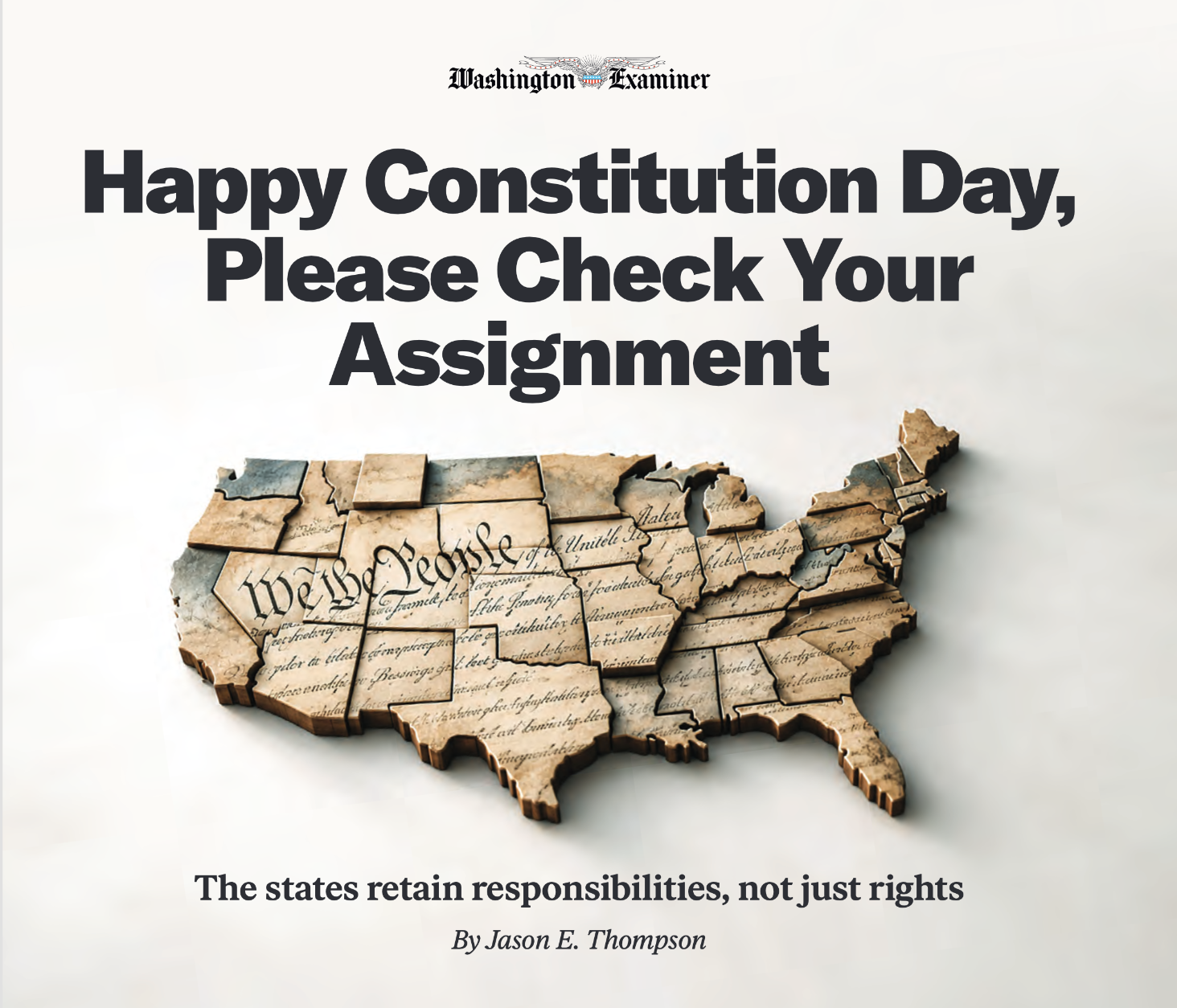
Happy Constitution Day, Please Check Your Assignment
The States Retain Responsibilities, Not Just Rights
September 11, 2026
Link to Published Article (Washington Examiner magazine Subscription Required)
By Jason Thompson
What is a state for?
That should be an easy question. We have fifty of them.
They have constitutions, governors, legislatures, courts, taxing authority, police powers, thousands of employees, and budgets that can make a small country's finance minister quite jealous. Americans spend considerable time and money trying to get elected to run them.
So what, exactly, are they supposed to do?
Here is a harder question. When a serious public problem arises, how do we decide which government should address it? Is the answer found in the Constitution? In the seriousness of the problem? In which government has the money, expertise, or personnel to do something about it?
Or, as increasingly seems to be the case, does a problem become Washington's responsibility once it becomes expensive, politically difficult, or capable of producing a cable-news segment?
Washington rarely suffers from a shortage of volunteers to appear on that segment.
This produces one of the stranger features of modern American government. State officials complain that Washington controls too much while traveling to Washington to ask for money.
Members of Congress denounce federal spending while explaining why the federal government should spend more back home. Citizens participate in the confusion too. We blame presidents for matters largely governed by states and demand congressional solutions to local problems.
It gets harder when the bill arrives. The bill always arrives.
Behind these generalizations is a serious constitutional problem. We are quite good at asking what Washington should stop doing. We are less practiced at asking which government possesses the authority to act, which has the capacity to act effectively, and which should be held accountable for the result.
Those distinctions matter as much this Constitution Day as ever. Federal programs intersect extensively with state budgets and policymaking. Congress confronts demands for national answers involving education, health, infrastructure, housing, public safety, and other subjects in which states and local governments also play large roles.
Sometimes national action is appropriate. Sometimes state action is. Often cooperation is unavoidable. But when responsibility becomes difficult to locate, our political system has developed an all-to-predictable habit: send the problem upward.
Increasingly, that means Washington.
The consequences extend beyond the familiar complaint that the federal government has become too large. More decisions become national decisions, raising the stakes of every presidential election and concentrating greater responsibility in the executive branch. Who can honestly say they are comfortable with the amount of power that has been centralized in the federal executive? Congress is asked to resolve an expanding range of problems for a vast and diverse country. Federal agencies are expected to administer policies across communities with very different needs and circumstances. Meanwhile, states can become less practiced, and sometimes less capable, at exercising authority that remains their own.
This should concern Americans regardless of which party controls Washington. A system that repeatedly concentrates difficult questions in the national government will eventually concentrate political power there as well.
To understand who should do what, we need to recover an idea once basic to the American constitutional system: Federalism is not primarily a doctrine about states’ rights. It is a constitutional structure that divides governing authority.
But recovering federalism requires more than defending the states against Washington. It requires asking what states are responsible for doing with the authority they possess.
Responsibility follows from authority, but the two are not identical.
Federalism's Missing Word
Federalism is a political system in which the national government and state governments each possess constitutionally grounded authority, neither simply subordinate to the other within the federal structure.
The word “federalism” never appears in the Constitution.
The structure is everywhere.
Underneath that structure is a principle even more basic: popular sovereignty.
The Constitution does not begin, “We the federal government.” Nor does it begin, “We the states.” It begins, “We the People.”
James Madison made the point especially well in Federalist No. 46. The federal and state governments, he wrote, are “different agents and trustees of the people,” entrusted with different powers. There is a useful word in that sentence: trustees.
A trustee possesses authority, but that authority exists for a purpose. He has an assignment.
The national government's assignment is substantial. Congress possesses enumerated powers over taxation, interstate and foreign commerce, naturalization, bankruptcy, national defense, and other subjects. Later amendments added important federal powers and responsibilities, particularly for protecting constitutional rights.
But the Constitution never gave the national government a general power to govern merely because a problem is important. The 10th Amendment confirms the structure: Powers not delegated to the United States, nor prohibited to the states, are reserved to the states respectively, “or to the people.”
Here we need to be careful. The 10th Amendment reserves powers. It does not hand every state legislature a federal job description. Nor does the rest of the U.S. Constitution comprehensively specify what every state government must do with the authority left to it.
To understand American federalism, one Constitution is not enough. We have fifty-one.
The U.S. Constitution establishes and limits the national government, restricts states in important ways, and structures the relationship between them. Each state also has a constitution establishing institutions, distributing governmental power, imposing additional limits, and often addressing subjects such as education, taxation, elections, public finance, and local government in much greater detail.
Constitution Day understandably directs our attention to the document drafted in Philadelphia. But American constitutional government has always depended on constitutions closer to home as well.
States are not empty spaces left over after federal powers have been counted. They are political communities with governments and constitutions of their own. And those governments have work to do.
Rights Are Only Half the Story
Our habitual language of “states’ rights” can obscure as much as it reveals.
Has Congress exceeded its power? Has an agency preempted state law? Has the federal government imposed an unconstitutional mandate? Those are legitimate federalism questions.
They are not the only ones.
Once we know a state possesses authority to act, harder questions follow. Does its constitution assign a duty to state government? Does the state possess the capacity to perform it? Is cooperation with Washington or neighboring states possible? Who will pay? And when the policy succeeds or fails, whom should voters hold responsible?
We have been reminded of this in meetings with state legislators from around the country. These are capable people dealing with real problems under considerable political and fiscal pressure. Most know the vocabulary of federalism: states’ rights, enumerated powers, federal overreach, the 10th Amendment, preemption. Yet conversations become harder when we move from vocabulary to responsibility.
That is not simply a problem for legislators. Our governments have become so intertwined that citizens and officials alike can struggle to identify where one government's responsibility ends and another's begins.
A state legislator is not a constitutional hall monitor whose principal job is catching Washington outside its assigned classroom. Nor is a state legislature the minor league of American government, where ambitious politicians play until a congressional seat opens.
It is a legislature.
But taking state government seriously also means acknowledging its limitations. States do not possess equal fiscal resources, expertise, population, or institutional capacity. Telling a state, “This is within your authority,” does not magically provide the personnel or money to govern effectively.
Authority matters. Capacity matters too.
Sometimes the States Opened the Door
Defenders of federalism should admit an uncomfortable fact: Washington did not accumulate all of its modern influence by kicking down the doors of state capitols. Sometimes the states opened the door. Sometimes they sent an application.
Federal money presents state lawmakers with an understandable temptation. Washington collects revenue nationally, sends some back to states, and frequently attaches instructions. State officials can complain about those instructions while explaining why refusing the money would be fiscally irresponsible.
Congress says: We are helping. The state says: We need the money. The federal agency says: Those are the rules.
The harder problem is accountability.
Greater independence can require states to raise revenue, cut another priority, build administrative capacity, or tell voters that something they want cannot be afforded. Those are unpleasant choices. They are also called governing.
The Supreme Court has said that “Federalism serves to assign political responsibility, not to obscure it.” Yet modern government can obscure responsibility remarkably well. A program may be funded by Congress, regulated by a federal agency, partly financed and administered by a state, and implemented locally.
Governors blame presidents. State legislators blame Congress. Congress blames state implementation. Agencies point to statutes. Everybody has jurisdiction. Nobody seems to have fingerprints.
Cooperation among governments may be necessary. Confusion about responsibility is not.
Supremacy Without a Blank Check
The Supremacy Clause is frequently invoked and incompletely understood. Article VI makes the Constitution supreme, along with federal laws “made in Pursuance thereof” and treaties made under the authority of the United States. The formulation here matters.
The Constitution is supreme; federal statutes are supreme when enacted pursuant to it.
Congress must possess constitutional authority to enact a federal law. When it validly exercises that authority, federal law can preempt contrary state law, and state officials cannot disregard it merely because they believe the policy is mistaken. Nor does federalism give states a general power to nullify federal statutes whenever state officials conclude that Congress exceeded its authority.
Constitutional disputes must be pursued through constitutional means: litigation, elections, legislation, intergovernmental negotiation, and, in extraordinary circumstances, constitutional amendment.
The Supremacy Clause does not enlarge Congress's legislative jurisdiction. It determines the status of valid federal law when federal and state law conflict.
Modern constitutional doctrine makes another structural point through the Supreme Court's anti-commandeering cases: The federal government may not simply order state or local officials to enact or administer a federal regulatory program.
States are governments, not administrative departments of the federal government. Their officials nevertheless operate within the same constitutional order.
Article VI requires federal and state officials to be bound by oath or affirmation to support the Constitution. That requires state officials to respect valid federal authority and constitutional limits on their own power, while challenging disputed federal action through lawful constitutional means.
That is constitutionalism.
The structure has to matter even when the preferred policy points elsewhere.
Federalism in the Real World
All of this can sound unnecessarily tidy on paper. Real governing is not.
Consider wildfires.
A major Western fire can move across federal land, state land, tribal land, county boundaries, and private property without pausing to consult a constitutional-law textbook. Federal agencies may possess substantial land-management and firefighting resources. States bring emergency powers, personnel, institutions, and knowledge of local conditions. Counties and municipalities may handle evacuations, roads, emergency services, and recovery.
Asking only, “Whose jurisdiction is this?” will not put out the fire. Capacity matters. So does coordination.
Federalism does not require fifty states to construct miniature versions of every federal institution. Nor does it require Washington to take charge of every problem crossing a jurisdictional boundary.
It requires harder judgments.
Who has constitutional authority? Who has practical capacity? Where is cooperation necessary? And when the smoke clears, who is accountable for what was done?
Federalism is not a promise that one level of government always knows best. It is a structure for governing a large and diverse country without assuming that one level always does.
Why Put Up With This?
Why maintain governments with overlapping jurisdictions, occasional conflicts, different laws, different tax systems, and armies of lawyers arguing about who gets to do what?
Because federalism's complications produce benefits.
One is diversity. A continental nation of hundreds of millions of people contains genuine differences in geography, economics, political preferences, and local conditions. Utah need not make every policy choice New York makes.
Federalism permits national unity without demanding national uniformity.
It also distributes information. Governments closer to a problem often know things institutions operating at a national scale cannot. Different states can try different approaches, observe one another, copy what works, and discard what does not.
Justice Louis Brandeis famously described a state as a laboratory capable of trying “novel social and economic experiments.” The metaphor has become a cliché, but consider the alternative: one national laboratory containing hundreds of millions of test subjects.
Federalism also divides political authority and brings much of government closer to the people. That principle does not stop at the state capitol. States distribute authority to counties, cities, towns, school districts, and other local governments. They are often where self-government becomes most tangible.
A citizen who has little realistic opportunity to influence Congress may be able to call a state legislator, attend a city council meeting, serve on a local board, question a school-board decision, or organize neighbors around a local problem.
Federalism does not guarantee that the government closest to the citizen will make the best decision. It does make more decisions contestable in more places.
Federalism After Appomattox
No serious defense of federalism can ignore slavery and the constitutional crisis that culminated in the Civil War.
The original Constitution left states with broad authority over the civil status and rights of their inhabitants while accommodating slavery. The national government's ability to interfere with slavery inside existing states was sharply constrained.
The Civil War exposed the consequences of that settlement catastrophically. Preserving the Union was no longer enough. The constitutional order also had to address slavery, citizenship, civil rights, and political participation in ways the original Constitution had not.
The Reconstruction Amendments did that work.
The 13th Amendment abolished slavery. The 14th established national constitutional guarantees of citizenship, due process, and equal protection against state action and gave Congress enforcement authority. The 15th prohibited racial discrimination in voting and likewise granted Congress enforcement authority.
The framers of those amendments were responding to the failures revealed by slavery, secession, and war while constructing rules for the postwar Union. Later violations by states, including Jim Crow, would make enforcement of those guarantees an enduring national struggle.
The Reconstruction Amendments changed American federalism profoundly.
They did not abolish it.
States retained broad authority, but that authority became subject to additional constitutional commands protecting individual rights. The national government, in turn, received new enforcement powers.
This history is another reason “states’ rights” is inadequate as our primary vocabulary. State authority exists inside a constitutional order that both empowers and restrains it.
A Better Question for Constitution Day
So, what is a state for?
Americans have been arguing about the place of the states since the beginning of the Republic. The language has changed over time, as have the issues, but many of our great federalism disputes have revolved around a familiar question: What authority belongs to the states, and what authority belongs to the national government? It is an important question. We should keep asking it.
But it is no longer enough.
Our federalism conversation has become too preoccupied with what states may defend against Washington and too inattentive to what states are expected to do with the authority they possess. We talk readily about states’ rights. We should begin talking just as seriously about states’ responsibilities.
That requires a different set of questions.
Within a constitutional federal system, a state is more than an administrative subdivision of the nation. It is a political community: a people organized within a defined territory, possessing institutions of self-government through which they govern matters arising from their particular circumstances, interests, and values.
Madison’s description is useful here. Governments are the people’s “agents and trustees.” A trustee does not merely defend what has been entrusted to him. He is expected to do something with it.
That is the shift our federalism conversation needs.
The 10th Amendment tells us that powers not delegated to the United States, nor prohibited to the states, are reserved to the states or the people. It does not provide a list of state responsibilities. For that, we must also look to state constitutions, state law, and the institutions the people have created to govern themselves.
So the question cannot stop at: Does the state have the authority?
We also have to ask: What responsibility follows from that authority? Does the state have the capacity to fulfill it? Where is cooperation with other governments possible? And who will be accountable for the result?
State legislators have a particular reason to understand those questions. But the responsibility is not theirs alone. Citizens need to understand the structure too. We vote for presidents, members of Congress, governors, legislators, mayors, county officials, and school boards. Yet we frequently blame whichever politician is most visible for decisions made somewhere else.
Federalism cannot work well if citizens know their states’ rights but cannot identify their states’ responsibilities. Citizens should be able to identify which government made a decision, which government is responsible for its consequences, and which officials they can hold accountable for success or failure. When authority, financing, implementation, and responsibility are divided among governments in ways that obscure who is actually responsible, federalism can weaken rather than strengthen democratic self-government.
That brings us back to Constitution Day.
We rightly celebrate the Constitution drafted in Philadelphia. But American constitutional government is larger than that document alone. The national Constitution exists alongside fifty state constitutions and thousands of institutions through which Americans govern themselves.
The arrangement is complicated.
It is supposed to be.
So when the next difficult problem arrives, our first instinct should not always be to ask what Washington will do about it. Nor should we reflexively insist that the states can handle it better.
Start somewhere more basic. Whose responsibility is this?
The answer may be federal. It may be state or local. It may require several governments working together. But one question should remain impossible to escape:
Who answers to the people for the result?
That is not the easiest version of federalism.
It may be the one we need.